Famous Criminals in History
Fame in crime is rarely about the body count alone. It is about what survives — the trial record, the press coverage, the photograph, the letter — and the story that endures in books and film. This archive exists for one such figure, Albert Fish; this page places him among the serial killers, gangsters and outlaws whose names still carry, and explains what kept each of them famous.

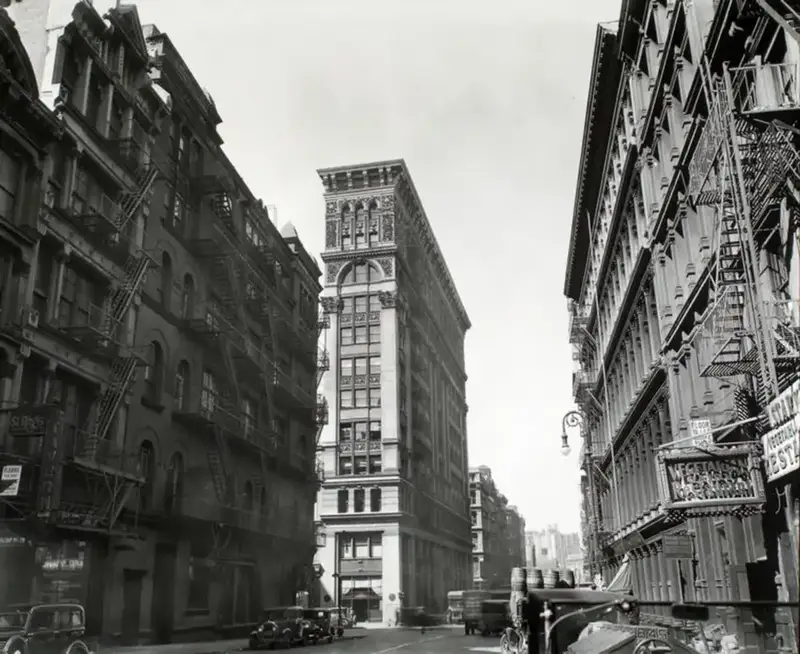
Image: Manhattan street scene, 1930s. Public domain in the United States. Via Library of Congress / Wikimedia Commons.
Albert Fish — the case at the centre of this archive
Albert Fish (1870–1936), United States. Born Hamilton Howard Fish, he is among the most infamous criminals in American history: a child molester, serial killer and cannibal whose best-known crime was the 1928 abduction and murder of ten-year-old Grace Budd. The case went cold for six years until, in November 1934, Fish mailed an anonymous letter to the Budd family describing the killing — a letter whose stationery led Detective William F. King to trace and arrest him. He was convicted at White Plains in March 1935 and executed in the electric chair at Sing Sing on 16 January 1936.
What keeps Fish famous is not only the horror of the crimes but the unusually complete documentary record they left: his own letters, the pelvic X-ray showing the needles he inserted into himself, the psychiatric testimony of Dr. Fredric Wertham, and the press nicknames — the Gray Man, the Brooklyn Vampire. For the full account, begin with the biography.
History's most famous criminals
Below is a cross-category reference. The dates are the years of the crimes for which each is remembered, not their full lifespans.
Notorious serial killers
Jack the Ripper (1888, United Kingdom). The unidentified killer of at least five women in London's Whitechapel district. Never caught, never named — which, with the era's sensational press, is precisely why the case became the most famous unsolved murder series in history.
H. H. Holmes (1890s, United States). Swindler and murderer linked to killings in his Chicago "Murder Castle" during the 1893 World's Fair. Often called one of America's first widely publicised serial killers; executed in 1896.
Ted Bundy (1974–1978, United States). Kidnapped, raped and murdered numerous young women across several states. Famous for his outward normalcy, his courtroom self-representation, and his recorded confessions; executed in Florida in 1989.
John Wayne Gacy (1972–1978, United States). The "Killer Clown," convicted of murdering at least 33 young men and boys, many buried beneath his Illinois home. Executed in 1994.
Jeffrey Dahmer (1978–1991, United States). Murdered 17 men and boys, with dismemberment and necrophilia. One of the most widely known late-20th-century killers; murdered in prison in 1994. Like Fish, a case where cannibalism fixed the killer in public memory.
Gangsters and organised crime
Al Capone (1920s–1931, United States). The defining Prohibition-era gangster, who ran Chicago bootlegging and racketeering before being convicted of tax evasion in 1931. The single best-known name in American organised crime; died in 1947.
John Dillinger (1933–1934, United States). Depression-era bank robber and escape artist who became an early FBI cause célèbre. Shot dead by federal agents outside Chicago's Biograph Theatre in 1934.
Bonnie and Clyde (1932–1934, United States). Bonnie Parker and Clyde Barrow, the romanticised outlaw couple of the Barrow Gang, responsible for robberies and several killings. Ambushed and killed by police in Louisiana in 1934.
Outlaws of the American West
Billy the Kid (1870s–1881, United States). Frontier outlaw of the Lincoln County War, mythologised almost beyond recognition in later folklore. Shot by Sheriff Pat Garrett in 1881.
What "famous" really measures
Read the list back and a pattern appears. The names that last are the ones with a surviving record and a retold story: Capone has the trial and the newsreels, the Ripper has the letters and the unsolved mystery, Fish has his own handwriting. Notoriety fades without documentation; fame is what remains when the documents — and the retellings — outlive the criminal. It is the reason an archive like this one exists at all.
Frequently asked questions
Who is the most famous criminal in history?
There is no single answer, but a few names recur on nearly every list: Jack the Ripper and Al Capone for sheer notoriety, and serial killers such as Albert Fish, H. H. Holmes, Ted Bundy and Jeffrey Dahmer for the scale and horror of their crimes. Fame tracks press coverage and cultural afterlife as much as the crimes themselves.
What makes a criminal famous rather than just notorious?
Lasting fame usually needs a documentary trail — trial records, press coverage, photographs or letters — plus a story that endures in books and film. Fish is remembered partly because his crimes were extreme and partly because his own handwritten letter survives as a primary document.
Was Albert Fish one of the most famous criminals in America?
Yes. Fish (1870–1936) is consistently ranked among the most infamous American criminals — a child murderer and cannibal convicted of killing Grace Budd and executed at Sing Sing on 16 January 1936.
Further Reading
Independent, non-Wikipedia sources vetted at the time of publication. External links open in a new window.
- FBI — Famous Cases & Criminals — The Bureau's own files on Dillinger, Capone, and others.
- Albert Fish press coverage — Newspapers.com search — Contemporary reporting on the Fish case, 1928–1936.
See: the Fish biography, the serial killer books, and the press nicknames. Return to the main archive.